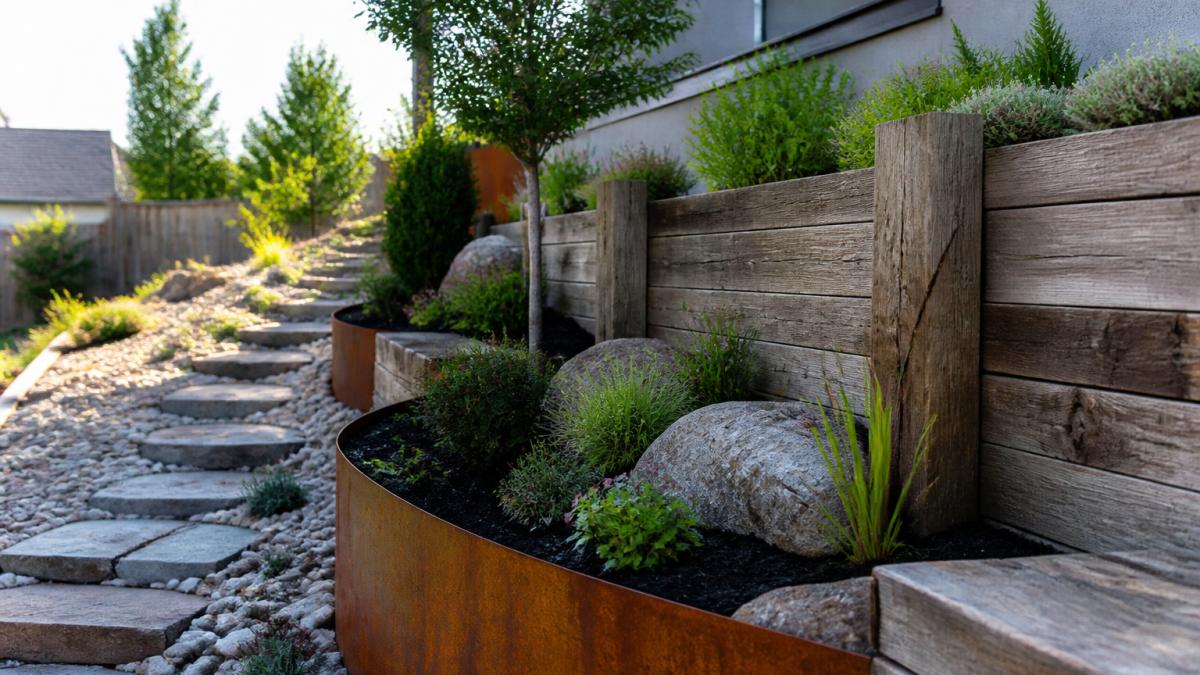
Cost Effective Retaining Wall Alternatives for Gardens
Table of Contents
- Retaining Wall Materials Compared: Cost Effective Options for Gardens
- Alternatives to Retaining Walls for Sloped Yards
- Garden Slope Stabilization: Drainage, Soil, and When to Call a Pro
- Frequently Asked Questions
Last Updated: October 4, 2026
Retaining Wall Materials Compared: Cost Effective Options for Gardens
Finding cost effective retaining wall alternatives for gardens starts with knowing which materials hold soil without draining your budget. The cheapest material is rarely the cheapest wall: excavation, drainage stone, backfill, labor and disposal usually outweigh the blocks themselves.
Below, we compare retaining wall alternatives by cost, lifespan and maintenance, plus no-wall options.
| Material | Relative Cost | Typical Lifespan | Maintenance |
|---|---|---|---|
| Landscape timbers | Lowest | Short | High; rot and insect damage |
| Concrete blocks | Low | Medium to long | Low |
| Gabion baskets | Low to medium | Long | Low |
| Natural stone | Medium to high | Very long | Low |
| Terraced beds (no wall) | Low | Long | Moderate |
Alternatives to Retaining Walls for Sloped Yards
Not every slope needs a wall. Terracing, planted embankments and graded beds often solve the same problem for less money and less risk.
Alternatives to retaining walls for sloped yards fall into two groups: structures that hold soil and landforms that manage it. The second group is where most homeowners find savings.
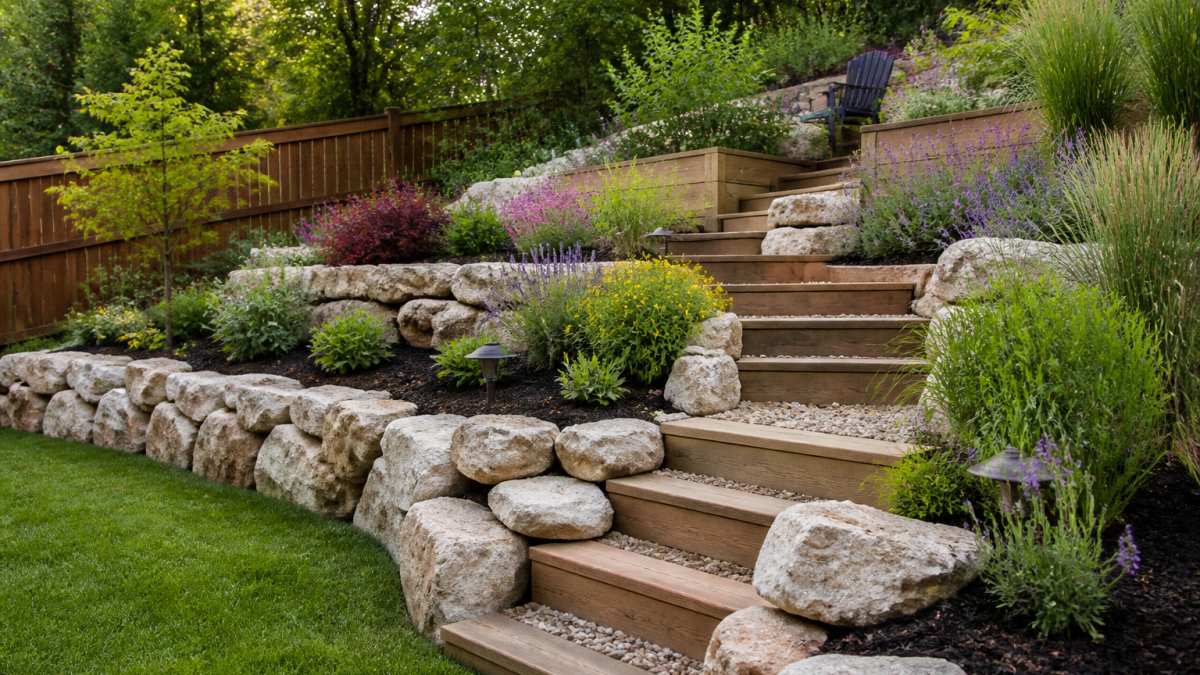
Terracing with garden beds
Cut the slope into level platforms, each held by a low border rather than a tall wall; short steps keep pressure low.
Planted embankments and erosion control
A slope planted with deep-rooted groundcover, shrubs and perennial grasses holds far more soil than bare ground, as roots bind the top layer. This is the lowest-cost option and the slowest to establish; expect a season or two, using temporary erosion control fabric or mulch until then.
Grading and drainage swales
Sometimes water pooling at the base, not the slope, is the problem. Regrading and cutting a shallow swale to redirect runoff can remove the need for a wall entirely. This is a job for a contractor with a laser level and a clear plan for where the water goes.
Garden Slope Stabilization: Drainage, Soil, and When to Call a Pro
Garden slope stabilization means holding soil in place on uneven ground using vegetation, grading, drainage and, where needed, structural walls. Water is the single biggest cause of retaining wall failure: saturated soil becomes heavier, and hydrostatic pressure behind the structure tips walls over and cracks them.
What good drainage looks like
A properly built wall manages water three ways: drainage stone backfill instead of packed soil, weep holes or a perforated drain pipe at the base, and filter fabric to stop fine soil clogging the stone.
Reading your soil
Clay holds water and swells, sandy soil drains fast but shifts, and silty soil washes out; each changes how much drainage you need. A simple jar test gives a rough answer: fill a jar a third with soil, top with water, shake, and let it settle; the layers show your sand, silt and clay proportions.
When to call a professional
Bring in a licensed contractor when the wall will be taller than about three feet, the slope shows movement, cracking or bulging, water pools at the base with no outlet, the wall sits near a property line, driveway or structure, or you are unsure about permits. Walls above a certain height, and walls that support a surcharge such as a driveway or building, typically need engineering and a permit. Requirements vary by jurisdiction, so check with your local building department before you dig. The International Code Council's building code resources outline how structural retaining walls are addressed in adopted codes.
Long-term ownership costs
The purchase price is not the whole story. Timbers need replacing as they rot. Block walls may need re-leveling if the base settles. Stone walls rarely need anything beyond occasional repointing. Ask how long you plan to stay. For a home you will sell in two years, a lower-cost material may make sense; for a forever home, paying more up front for stone or properly built block usually costs less over twenty years than replacing a timber wall twice.
A sloped yard is one of the fastest ways to add usable space and curb appeal when it is done well. Luxury Concrete And Landscaping designs and builds retaining walls, patios and full landscape transformations across Utah, with an in-house design team, premium materials and a 5-year workmanship warranty behind every project. We are licensed, bonded and insured, so the liability and the permits stay with us, not you. Get started with Luxury Concrete And Landscaping and turn that slope into outdoor space you actually use.
Frequently Asked Questions
What are cost-effective alternatives to a retaining wall in a garden?
Landscape timbers, concrete blocks, gabion baskets, and salvaged concrete are among the lower-cost retaining wall alternatives for gardens. Terracing with garden beds and sandbags can also hold soil on gentle slopes. Material cost varies by region, quantity, and site conditions, so request a quote rather than relying on national averages. For slopes over about three feet, professional evaluation is worth the cost because a failed wall is far more expensive than doing it right the first time.
Can sandbags be used to hold back soil in a garden?
Sandbags can temporarily hold back soil on low, gentle slopes, but they degrade under UV exposure and are not a permanent garden slope stabilization method. They work best as a short-term fix after heavy rain while you plan a proper solution. For anything steeper than a shallow grade, or where water pressure builds behind the bags, plan a permanent alternative such as timber, blocks, or a professionally built wall.
When does a garden slope need professional stabilization?
Call a professional when the slope exceeds roughly three feet in height, when water pools or seeps at the base, when you see cracks, bulges, or leaning in an existing wall, or when the soil is clay-heavy and slow to drain. These signs point to water pressure and soil conditions that simple DIY alternatives cannot safely handle. A licensed contractor can assess drainage, soil type, and structural limits before recommending a fix.
