Retaining Wall Drainage System Installation Guide
Table of Contents
- Why Every Retaining Wall Needs a Drainage System
- Step-by-Step Retaining Wall Drainage Installation
- Retaining Wall Weep Hole Placement and Best Drainage Gravel
- Frequently Asked Questions
Last Updated: September 7, 2026
A retaining wall drainage system installation guide is essential for any homeowner, because a wall without proper drainage is a wall waiting to fail. The primary culprit is hydrostatic pressure, the force exerted by water-saturated soil pushing against the back of your wall (nh.gov). This guide walks you through the critical steps to protect your investment.
Why Every Retaining Wall Needs a Drainage System
The most common retaining wall failure is caused by water. When saturated soil expands, hydrostatic pressure can bow, crack, or topple the wall. A proper drainage system relieves this pressure by capturing water at the base and redirecting it safely away.
A common mistake is assuming a few inches of gravel is sufficient. Drainage aggregate must work with a perforated pipe and proper outlet to create a continuous path for water to escape before pressure builds.
Step-by-Step Retaining Wall Drainage Installation
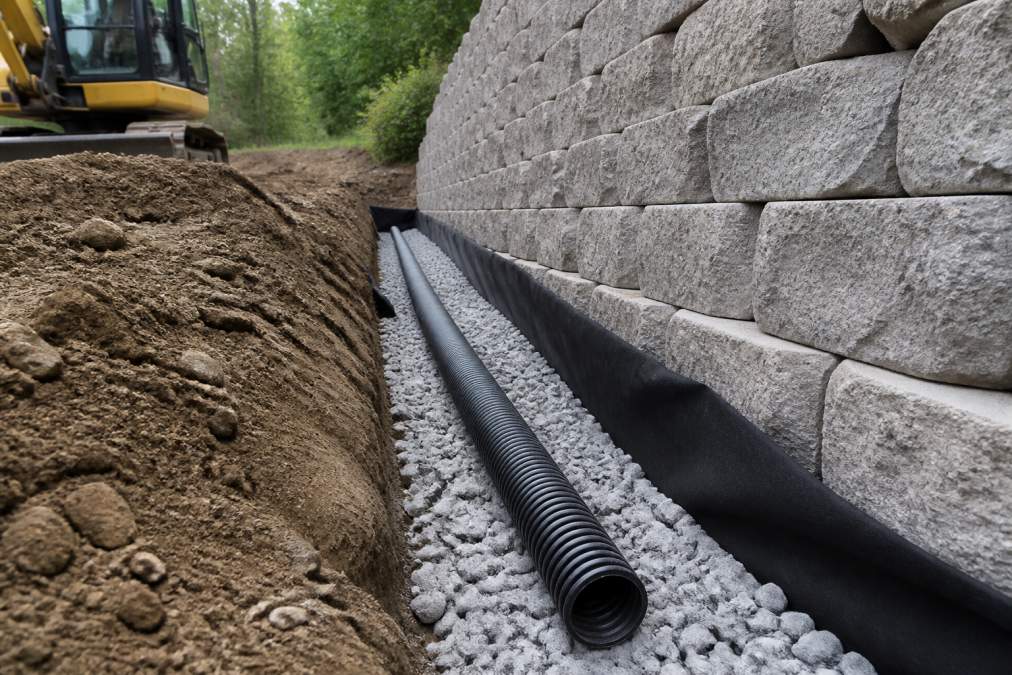
Step 1: Excavate and Prepare the Base Dig a trench wide enough for the wall blocks plus at least 12 inches of drainage aggregate behind them. Level and compact the subgrade to prevent settling.
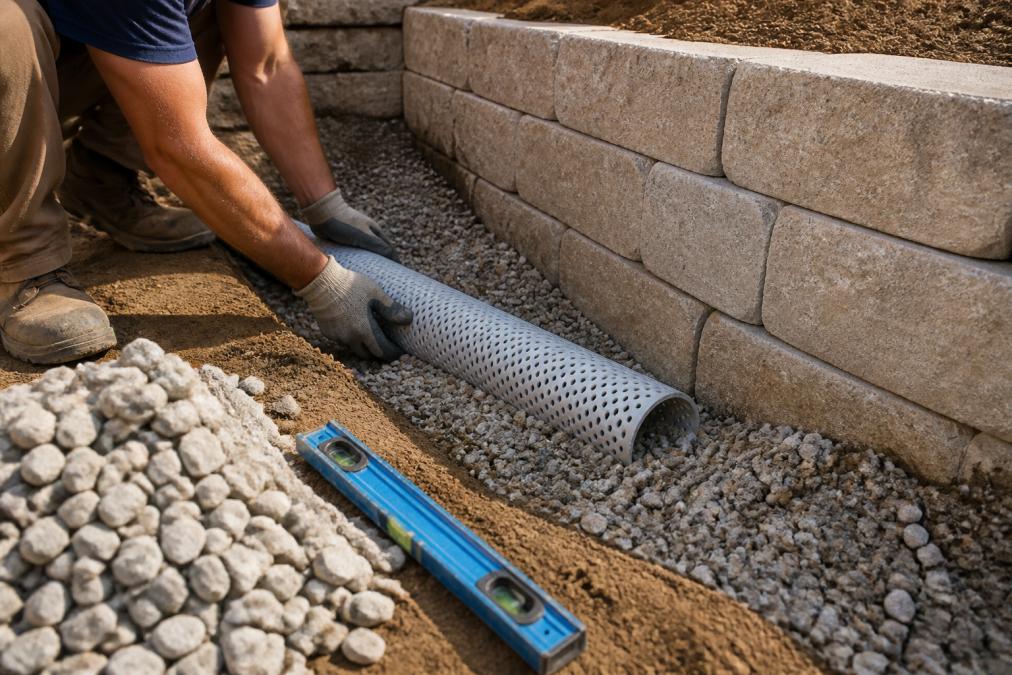
Step 2: Lay the Drainage Pipe Place a 4-inch perforated pipe at the base, behind the wall, with a slope of about 1 inch per 8 feet toward the discharge point (iastate.edu). Perforations face downward to capture water.
Step 3: Backfill with Drainage Aggregate Cover the pipe with clean, angular drainage aggregate, which allows water to flow to the pipe while preventing soil from clogging the perforations.
Step 4: Install Geotextile Filter Fabric Line the excavation with geotextile filter fabric before backfilling. It keeps fine soil out of the aggregate; without it, the system clogs and recreates hydrostatic pressure.
Retaining Wall Weep Hole Placement and Best Drainage Gravel
For surface drainage, weep holes should be placed in the first or second course, spaced every 3 to 4 feet, as a secondary discharge point (concrete.org).
Choose clean, crushed stone in the 3/4-inch to 1-inch range for the best drainage gravel. Avoid sand or fine gravel, which compact and hold water.
The real difference between a wall that lasts decades and one that fails in five years often comes down to backfill calculations. For most residential projects, a full drainage system with pipe, aggregate, and fabric is the safest choice.
Heavy clay soils hold water longer and require a more strong drainage system than sandy soils. If unsure about your soil, a professional consultation can save costly repairs.
Building a retaining wall without a drainage system is like building a house without a roof. A proper retaining wall drainage system installation guide is your best defense. At Luxury Concrete And Landscaping, we build retaining walls with precision and lasting beauty, backed by a comprehensive 5-year workmanship warranty. Our licensed and insured team handles every detail, from in-house design to on-time delivery. Get My FREE Estimate and let us build a wall that stands strong against the elements.
Frequently Asked Questions
Does every retaining wall need a drainage pipe?
Most retaining walls over four feet tall need a perforated drainage pipe to prevent hydrostatic pressure. Walls under this height may rely on a gravel drainage blanket and weep holes. However, soil type matters. Heavy clay soils hold water and require full drainage even at lower heights. A licensed contractor can assess your site conditions and recommend the right system for your retaining wall drainage.
What is the best drainage gravel for retaining walls?
Clean, crushed stone in the 3/4-inch to 1-inch range works best for retaining wall drainage. This is often called drainage aggregate or clean stone. It must be free of sand and dirt, which clog the spaces between rocks and stop water flow. Avoid rounded pea gravel, as it compacts and locks together. The open voids in crushed stone allow water to move quickly down to the perforated pipe.
What happens if a retaining wall does not have proper drainage?
Without a proper retaining wall drainage system, water saturates the soil behind the wall. This builds hydrostatic pressure, which pushes against the structure. Over time, this pressure causes the wall to bow, crack, or lean forward. Freeze-thaw cycles worsen the damage. Proper drainage, including a perforated pipe and weep holes, relieves this pressure and protects the wall's structural integrity.
