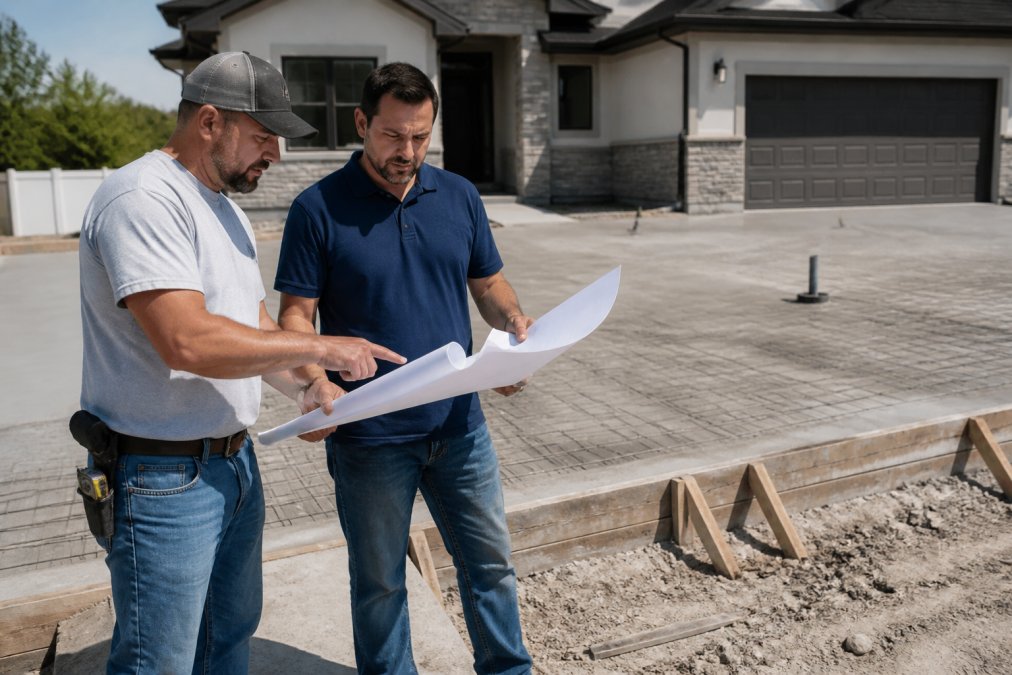
Questions to Ask Concrete Contractors Before Hiring
Table of Contents
- How to Verify Contractor Insurance and Licensing
- Concrete Project Estimate Breakdown: What Every Line Item Means
- Red Flags When Hiring Home Improvement Contractors
- Importance of Concrete Workmanship Warranties
- Frequently Asked Questions
Last Updated: September 13, 2026
How to Verify Contractor Insurance and Licensing
Ask concrete contractors for proof they are licensed and insured. A licensed and insured contractor carries liability and workers compensation coverage and can produce a certificate of insurance on request (osha.gov).

Ask, in order: license number and certificate of insurance; whether the policy covers general liability and workers compensation; whether bonding is current and with whom; and whether you'll get a written estimate and a contract naming the insured entity.
A common mistake is accepting a verbal "we're insured" without seeing paperwork. Ask for the certificate directly and call the insurer to confirm it is active. Utah Division of Occupational and Professional Licensing maintains a public license lookup you can search before signing anything.
Concrete Project Estimate Breakdown: What Every Line Item Means
A concrete project estimate breakdown should itemize materials, labor, site preparation, and finishing. A lump-sum figure cannot be compared to another bid or checked for a lowball.
| Line Item | What It Covers | Why It Matters |
|---|---|---|
| Site preparation | Excavation, grading, compaction | Poor prep causes settling and cracks |
| Concrete mix | PSI rating, reinforcement, thickness | Determines structural integrity |
| Labor | Crew size, days on site | Affects project timeline |
Ask concrete contractors to state the concrete mix PSI and the reinforcement spec in writing. Concrete mix specifications and PSI requirements are the technical detail most bids skip, and they are exactly what determines whether a slab holds up. The American Concrete Institute publishes standards for mix design and curing.
Red Flags When Hiring Home Improvement Contractors
The clearest red flags when hiring home improvement contractors are large upfront cash demands, no written contract, and pressure to decide on the spot. One should slow you down; two or more should end the conversation.
Watch for a big deposit before materials are ordered, no written estimate, a contract missing scope of work and payment schedule, refusal to put change orders in writing, no physical address or project portfolio, and vague answers about subcontractors.
Contract terms matter more than a handshake. A legitimate contractor expects you to read the contract and ask about warranty, permits, and inspections before signing.
Importance of Concrete Workmanship Warranties
A workmanship warranty protects you if the concrete cracks, the surface fails, or a retaining wall shifts after the crew leaves. Materials warranties cover the concrete; a workmanship warranty covers installation, where most failures originate.
Ask what the warranty covers and excludes, how long it runs, whether it transfers if you sell, and how you file a claim.
At Luxury Concrete And Landscaping, we back our installations with a comprehensive 5-year workmanship warranty, in writing. A warranty you cannot find in the contract is not a warranty.
Frequently Asked Questions
What licenses and insurance should a concrete contractor have?
Ask for a state contractor license number, general liability insurance, and workers compensation coverage. Call the insurer directly to confirm the policy is active and covers concrete work. A legitimate concrete contractor will provide these documents without hesitation. If they cannot produce a certificate of insurance or a verifiable license, walk away. This protects you from liability if a worker is injured or property is damaged during the project.
What should be included in a written concrete project estimate?
A complete estimate lists site preparation, excavation, base material, reinforcement, concrete mix and PSI rating, finishing techniques, curing process, cleanup, and a payment schedule tied to milestones. It should also state the project timeline and how change orders are handled. Ask for a concrete project estimate breakdown so you can compare bids fairly. Vague estimates with lump sums make it easy for contractors to add charges later.
How long should a concrete driveway or patio typically last?
A properly installed concrete driveway or patio can last 30 years or more with correct mix design, reinforcement, and curing. Cracking often traces back to poor site preparation, inadequate base compaction, or skipping control joints. Ask your contractor what PSI mix they use and how they handle expansion joints. A workmanship warranty backs those choices. Without one, you absorb the cost of early failures.
Hiring a concrete contractor comes down to verification: license, insurance, a detailed written estimate, and a warranty you can actually use. Luxury Concrete And Landscaping handles all four, with in-house design, a licensed, bonded, and insured team, and a 5-year workmanship warranty on every project. Get my free estimate and start your project with a contractor who answers every question before you sign.
