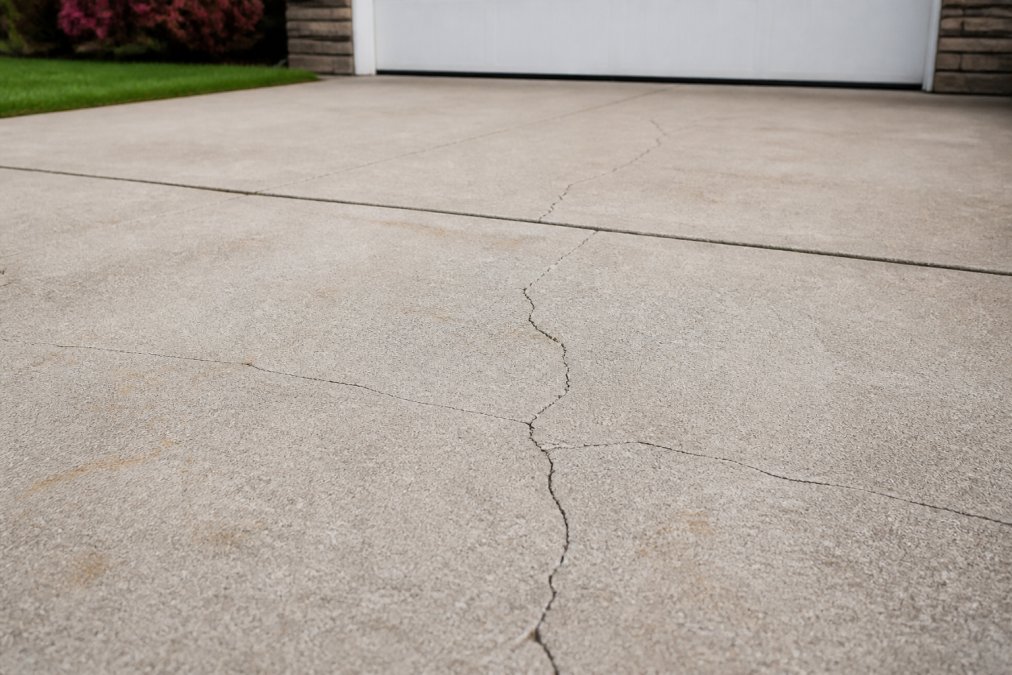
Why Does My Concrete Driveway Have Small Cracks?
Table of Contents
- When to Worry About Concrete Cracks: Hairline vs. Structural
- How to Repair Hairline Cracks in Concrete
- Preventing Concrete Surface Cracking
- Frequently Asked Questions
Why Does My Concrete Driveway Have Small Surface Cracks?
Small surface cracks, often called crazing or plastic shrinkage cracks, typically form during the first few hours after the concrete is placed. These hairline cracks are usually cosmetic, but understanding why they appear helps you decide between a simple repair and a call to a professional.
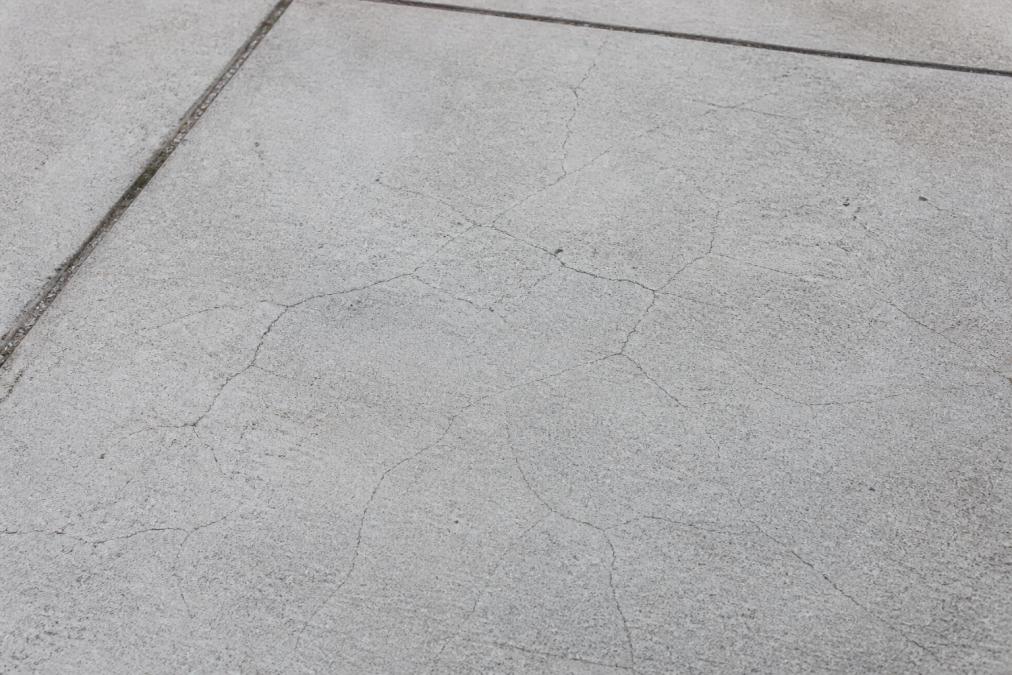
Plastic shrinkage is the most frequent culprit. When concrete is poured, excess water rises to the surface and evaporates. If the air is dry, windy, or hot, moisture leaves the surface faster than the concrete can replace it, creating tension that pulls the top layer apart, leaving shallow, irregular cracks that rarely extend deeper than a quarter of an inch.
Crazing produces a similar pattern but comes from finishing the surface too early or over-troweling. Working the surface while bleed water is still present weakens the top layer, leaving a network of fine map-like cracks once it dries. Both conditions are cosmetic in most cases, though they can widen over time if water freezes inside them. The Portland Cement Association guidance on concrete cracking notes that most surface cracks do not affect structural integrity when they appear within the first few weeks.
When to Worry About Concrete Cracks: Hairline vs. Structural
Hairline cracks narrower than a credit card, roughly 1/16 of an inch, that stay uniform across the surface are almost always cosmetic. Structural concrete driveway cracks are wider, run through the full depth of the slab, or show signs of settlement where one side sits lower than the other.
Watch for these warning signs that indicate a deeper problem:
- Cracks wider than 1/4 inch that continue to grow
- One side of the crack is higher than the other, indicating settlement
- Cracks that run diagonally across the entire slab
- Water pooling along the crack line after rain
- Visible rust staining, which suggests reinforcement is exposed
The freeze-thaw cycle is the biggest reason cosmetic cracks become structural ones. Water seeps into a hairline crack, freezes, and expands with enough force to widen it season after season.
Control joints are the intentional straight grooves cut into a slab to direct where cracking happens. When joints are placed too far apart or omitted entirely, stress has nowhere to go. Proper spacing for a residential slab is generally every 10 to 12 feet, with the cut depth at least one-quarter of the slab thickness.
How to Repair Hairline Cracks in Concrete
For cosmetic surface cracks, you are sealing the crack to keep water out, not restoring structural strength. A common approach is to use a polymer-modified concrete crack filler or a polyurea-based sealant designed for driveways.
The process takes about an hour for an average two-car driveway:
- Clean the crack with a wire brush and blow out the dust with compressed air or a leaf blower
- Rinse the area with water and let it dry completely
- Apply the crack filler using a caulk gun, slightly overfilling the crack
- Smooth the filler flush with a putty knife
- Allow the filler to cure according to the manufacturer's instructions before sealing or driving on the surface
For slightly wider cracks up to 1/4 inch, use a sanded filler that can handle minor movement without re-cracking. Epoxy repair products work well here because they bond tightly and resist water penetration.
Crack injection involves drilling small ports into the crack and injecting epoxy or polyurethane under pressure so the material penetrates the full depth. This is the right approach for cracks that pass through the entire slab but show no signs of structural movement.
| Crack Type | Width | Repair Method | When to Call a Pro |
|---|---|---|---|
| Plastic shrinkage | Under 1/16 inch | Surface sealant | Never, cosmetic only |
| Crazing | Under 1/16 inch | Surface sealant | Never, cosmetic only |
| Hairline (settled) | 1/16 to 1/4 inch | Sanded filler or epoxy | If crack is active |
| Full-depth | Over 1/4 inch | Epoxy crack injection | Always, assess structure |
| Settlement | Any, with vertical offset | Slab replacement or mudjacking | Always, subgrade failure |
Preventing Concrete Surface Cracking
Prevention starts before the concrete is poured. The single most important factor is the water-to-cement ratio. More water makes the concrete easier to work with, but it also weakens the final product and increases shrinkage as the excess water evaporates.
Concrete reaches its design strength only if it stays moist for the first seven days, allowing the hydration process to continue. If the surface dries too quickly, hydration stops and the top layer remains weak and prone to crazing.
Proper curing methods include:
- Applying a curing compound that forms a moisture barrier on the surface
- Covering the slab with wet burlap or plastic sheeting
- Keeping the surface misted for the first 48 hours
- Waiting at least 24 hours before foot traffic and seven days before vehicle traffic
Subgrade preparation is the other half of the equation. A slab poured over loose soil, organic material, or inadequately compacted fill will settle unevenly, and the concrete will crack to accommodate the movement. Proper compaction before pouring reduces this risk substantially.
Control joints should be cut within 24 hours of finishing, before the concrete develops its full tensile strength. Expansion joints between the driveway and the garage floor or house foundation also allow for thermal expansion without transferring stress to the slab.
The American Concrete Institute's guide to concrete slab construction emphasizes that joint spacing and curing are the two most commonly neglected steps in residential concrete work. Both are invisible once the job is done, which makes them easy to skip, but both determine whether your driveway shows fine surface cracks or stays clean for decades.
If you are planning a new concrete driveway and want to avoid surface cracking from the start, the installation team matters as much as the mix design. Luxury Concrete And Landscaping handles the full process from in-house design to on-time delivery, with proper subgrade compaction, control joint placement, and curing built into every project. Our licensed and insured crew backs the work with a 5-year workmanship warranty, so you have a clear path if issues arise after the pour. Concrete construction best practices from the National Ready Mixed Concrete Association support the methods we use on every residential slab.
Frequently Asked Questions
Is it normal for a new concrete driveway to crack?
Yes, small surface cracks are common in new concrete driveways. As the concrete cures, water evaporates and the slab shrinks. This process creates internal stress that often results in hairline cracks, especially within the first few months. This is known as plastic shrinkage cracking and is typically cosmetic. These fine cracks do not affect the structural integrity of your driveway. However, if you see cracks wider than 1/4 inch or with vertical displacement between the sides, call a professional for an evaluation.
What is the difference between shrinkage cracks and structural cracks?
Shrinkage cracks are typically hairline, less than 1/8 inch wide, and appear soon after the concrete is poured due to moisture evaporation during curing. They are a cosmetic issue. Structural cracks are wider, often grow over time, and may be accompanied by one side of the crack being higher than the other. These can signal problems with the subgrade, soil movement, or load-bearing capacity. If you are unsure whether your driveway cracks are simply cosmetic or a sign of a larger issue, contact a licensed concrete contractor for an assessment.
How can I fix small cracks in my concrete driveway?
For hairline cracks that are purely cosmetic, a concrete crack filler or sealant designed for driveways works well. Clean the crack of debris, then apply the filler using a caulk gun and smooth it with a putty knife. For slightly wider cracks, you can use a sand mix or a pourable crack filler. These repairs prevent water from seeping in and worsening the crack during a freeze-thaw cycle. If cracks are structural or you are planning a larger driveway renovation, discuss repair options with a professional.
Concrete surface cracks are common, but they are not inevitable. Understanding why they form, knowing which ones matter, and catching them early keeps a cosmetic issue from becoming a structural one. Get started with Luxury Concrete And Landscaping and get a driveway built to stay clean for years. Get My FREE Estimate.
